Welcome to another installment of the
Literary Blog Hop, a delightful and thought-provoking meme in which our hosts at The Blue Bookcase challenge us to think and write intelligently about literature. I don't know if I'll succeed in that lofty goal, but we'll give it a shot. (Confession: Since my answer to the prompt question this month could be considered controversial, I deliberatelty waited until after I'd written this post to read anyone else's posts for the month. If I sound like I'm directly echoing someone else, or challenging someone else, please know that it was entirely unintentional.)
This month, we're discussing how to interest the "anti-literature" camp in our favorite supergenre. What do you recommend to the person who says they "don't like 'literature'?"
 |
| Photo by Tom Murphy VII |
I once had a literature professor in college who assigned us a reading by John Ruskin, just so we could see what BAD literature was like. And told us so! Let's face it--some of what people consider "literature" deserves to be disliked. If all this person can see in her mind when she hears the term is deathly boring tripe written by dead people, it's hardly surprising that she's not interested. I think we have to shake up people's understanding of what literature is a little bit. (In this respect, I find the definition that the Blue Bookcasers themselves give quite useful, and I can do no better than to paraphrase it.) "Literature" is meant to denote a written work that will outlast many of its peers not because it is a real page-turner--though that certainly helps--but because it is in some way ground-breaking, challenging, eye-opening. It doesn't have to have been written in a previous century to be good literature.
Perhaps one of the best ways to demonstrate this is to recommend a book that your "non-literary" friend wouldn't expect to hear you call "literature". I hold degrees in both linguistics and English, and one thing I've learned is that average human beings never give themselves enough credit for being rational. Native speakers of English often say things like, "Oh, I don't speak good English, or at least, I don't speak it properly." A perfectly constructed, grammatically correct English sentence about how a person who has spoken English since infancy doesn't speak her own language! It's quite possible that people who enjoy reading, yet say they "don't like literature," aren't giving themselves enough credit for making good book choices, and aren't crediting their favorite authors with the ability to craft a literary novel.
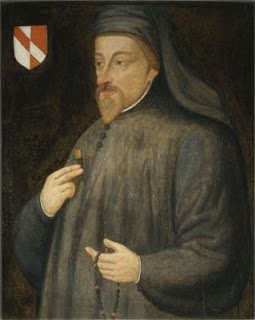 |
| 17th-Century Portrait of Geoffrey Chaucer |
Now, am I suggesting that Debbie Macomber's or Richard Paul Evans' works be considered great literature? Hardly. I like Debbie Macomber, but I wouldn't vote for her stuff to appear in the next Norton Anthology of American Literature. However, the ability to distinguish "literature" from "a good yarn" has a lot to do with simply getting some education on the subject, and sometimes, people read books with "literary merit" without knowing they've done so. Really good authors can slip the "literature" inside an ooey-gooey delicious coating of fluff and have many of their readers never be the wiser, like parents slathering their children's broccoli with cheese sauce. Even readers who sat through entire semesters on Chaucer, Shakespeare and Dante--which I did--can dive into these books and enjoy the literary merit, or not, as they choose.
Which brings me to my actual answer to this question. If a friend of mine who loved to read said she couldn't stand "literature," my immediate response would be, "Ever read Harry Potter?"
Leaving aside all those who think Harry Potter is the Spawn of Satan, and those who just can't stand fantasy fiction, the majority of responses would probably be something along the lines of, "Yeah, but that's technically for kids, isn't it? I liked it, even though I'm an adult, but I felt kind of funny about that." Or else, "Oh, they were awesome, but I'd hardly call that literature, would you?!"
To which I would respond, "That's EXACTLY what I'd call it, and there's a reason that so many adults liked those 'children's' books."
I may get major argument on this one, but in her Harry Potter series, J.K. Rowling encapsulated many of the most fundamental literary tropes in the Western canon--the archetypal mother (Lily), the voice of wisdom and reason (Hermione), the hero of epic (guess who?). Hermione's like a one-woman Greek chorus, for heaven's sake, except that the hero actually hears her and stops doing some stupid things!
 |
| A Brownie |
More importantly, Rowling touched on some of the oldest human themes ever known, dating back far before anyone discussed the narrative arc of exposition, complication and denoument. Harry Potter is the messiah figure who in turn is simply the dying god of the world's most ancient religions--some of which are still living and are now MODERN religions. Moreover, no one can dispute that in the Wizarding World, we have a narrative vehicle that is unique, a structure that adds to the scope of human expression and therefore has literary merit in and of itself. Within that vehicle, this series is bursting with references to classical and medieval folklore. Unlike many of its modern fantasy, pulp fiction cousins, however, Harry Potter does not twist those classic human imaginings into new and unrecognizable shapes to make them convenient plot devices. In fact, Rowling challenges us to find out what many of these creatures used to mean to our ancient or medieval forebears. Were you aware that if you left clothes out for fairies/brownies, they would take offense and leave your house? I didn't know that my European ancestors believed that, until reading Harry Potter made me decide to research it.

Obviously, this is only a starting point, but it is a VALID starting point, and if my "anti-literature" friend said she'd never read any of them, I would send her off to the bookstore with stern orders to not let her head hit the pillow that night until she'd at least read "Chapter 1--The Boy Who Lived". It would be the first step toward preparing her to discuss Christ, Mithras, Osiris and Horus, as well as the works of Joseph Campbell and Edith Hamilton. If she revealed that she was a Potter maniac, I would then say, "Excellent! How about we read
Beowulf or
The Odyssey together now? If you liked Harry Potter, you just might love one of those two!"


