Showing posts with label 3.5 Stars. Show all posts

January 15, 2014

Sister Fidelma Goes to Whitby

Absolution by Murder
by Peter Tremayne

Honestly, I have very mixed emotions about this little mystery novel. It is set at and during one of the most important events in the history of Christianity in the British Isles, a famous local council known as the Synod of Whitby.


St Hilda, shown holding
her abbey at Whitby
Some of my favorite saints in the early British church were involved in this synod, the subject of which was to determine whether or not the Christians of Britain would fall into line with liturgical and ecclesiastical practices promulgated by Rome. I especially admire St. Hilda of Whitby, abbess of a monastic establishment that housed both men and women; she was an amazing and formidable figure, as were many of the others who participated in the council.


Ruins of the Abbey of Whitby
Photo by Hugh Chappell

Indeed, this whole event is one of my favorites in British history (even though I can easily wax romantically nostalgic about the elements of Celtic Christianity that began to disappear as a direct result), which confirms my Geek status for life. So I loved reading this novel about it, but felt very ambivalent about some aspects of the author's handling of it, and especially his characterizations of some of the historical figures involved.


As a mystery, this book is acceptable, about average, but the starring sleuth, Sister Fidelma of Ireland, is quite an enjoyable character. She is an attorney, of all things, a legal expert recognized in the medieval Irish courts. Who knew that women could do such things in 7th-century Ireland? Sister Fidelma was a lot of fun; the rest of the book was readable, but not exemplary.

October 07, 2012

A Review of "The Casual Vacancy"

The Casual Vacancy
by J.K. Rowling

I finished this book in a mad dash at 4:00 a.m. this morning.  It is now nearly 10:00 p.m., and after giving myself the whole day to process it, I have to sit down and review it while it's still a fresh wound on my mind.  I don't use the word "wound" in an entirely perjorative sense; after all, when a surgeon recently repaired a hernea for me, I was very grateful to have him do so.  However, the large incision he made in the process was certainly a wound nonetheless.  And honestly, I'm still not sure how grateful I am to J.K. Rowling for the experience of The Casual Vacancy, but certainly not as grateful as I was to my surgeon.  Of that I have no doubt whatever.

All of us knew going in that there would be no magic or centaurs or floo powder in this book.  We wished we were wrong about that, but we knew that we weren't, and that all the publicity for this book had pointedly reminded us over and over that this is Rowling's first book solely for ADULTS.  Yet my overriding impression throughout most of the book was that this book was for Rowling what Equus was for Daniel Radcliffe--it was as if she wanted to shock, to prove that she does know stronger swear words than, "Bloody hell!", and is aware that teenagers actually have sex every day all over the world.

The language of this book is extremely crude.  I never met a swear word I didn't love, and I routinely ruffle people's feathers before I remember that not everyone employs the full force of the English language in ordinary, dispassionate conversation.  So, I really wasn't that bothered by the language, but I know many, many people who would never have survived past the first chapter or two.  They would have been desperate to bleach their brains.  The much greater challenge for me was the actual content of the book.  Nearly everything that took place from start to finish was on a scale of negativity ranging from unpleasant to totally horrific.  Until the very end, there's hardly a single character that you can actually like.  It is just an unrelenting onslaught of hateful human thought and behavior and depressing, tragic events.  If the book had been by almost ANY other author, I would've given up in disgust very early on.

Here's why I didn't.  There were several moments in the last three or four Harry Potter books at which I thought, "Oh, my gosh!  She's finally let the whole thing get away from her.  My favorite series is about to jump the frigging shark!!"  She always pulled it off in the end.  After the genuinely epic Harry Potter saga, I had learned to trust J.K. Rowling.  Implicitly.  So I barrelled on through this tale of woe, often thinking to myself, "I am used to your writing always ending with an absolutely life-affirming larger message.  How on EARTH are you going to manage that in these last 100 pages, Jo?!"


I'll be damned if she didn't manage it in the end.  I was absolutely gob-smacked that she pulled it out of the fire, but she did.  I kept thinking that in order to try and put a decent ending on this long, drawn-out tragedy, she'd have to make people change so much and behave so completely out of character that she'd just be blowing sunshine up our asses, and it would be completely unbelievable.  But let us never forget that when all is said and done, the woman can WRITE!  My God, she can write, and she managed it in the end.  I think the only question will be whether that ultimate payoff will be big enough for others who wade through all the misery to get to it.  For me, it was--barely.

April 04, 2012

Review of "They Came to Baghdad"

by Agatha Christie

Accustomed as I am to thinking of all of Agatha Christie's novels being set in the Gilded Age or the Roaring '20s, I was astonished at first to find out that this one takes place in the thoroughly war-weary Europe of 1951.  (Indeed, I had no idea until I read the blurb at the end that Agatha Christie and I only missed being in the world at the same time by one year.  Elvis and I only missed each other by TWO WEEKS, and I've always felt rather cheated about it, even though he does annoy me mightily.  Sorry--I digress.)

The basic idea here is that a large, disparate cast of characters--primarily, a rather silly young woman--find themselves entangled in international intrigues.  Although this is only the second Agatha Christie book I've ever read, I have to say that I don't think this one is typical Christie fare, so devoted fans might be disappointed in it.  It focuses so heavily on the evil, pointless futility of war that it almost turns into a sermon near the end.

That said, however, I have to admit that I liked this book, though I really didn't expect to at first, because the heroine got on my nerves.  I've never had much use for people who habitually lie just to liven up their everyday, hum-drum lives, and Victoria Jones is the queen of the recreational liars.  However, the author quickly taught me how useful that character "flaw" can be to a woman who accidentally finds herself embroiled in espionage!


I did manage to figure out who was "behind it all" before Victoria did, which is always my main criterion for whether or not I "succeeded" in reading a mystery novel, but I think I really should have figured it out even before I did.  This book was a fascinating glimpse into Agatha Christie's mind, into the view of the Cold War world.  I'd be interested in reading her diaries or letters from the time, to find out what she was thinking as she crafted the plot.  Either way, I enjoyed it, and at least the heroine didn't do many of the stupid things that so annoy me in a lot of other books.  She's bright and very quick at thinking on her feet, even if she isn't fond of veracity.

October 19, 2011

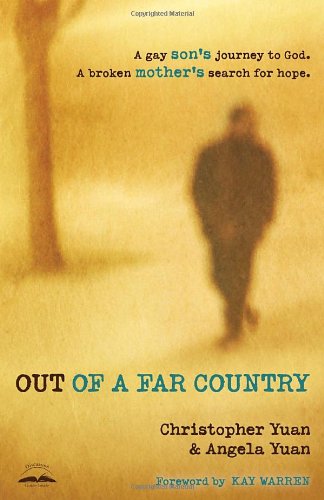
Review of "Out of a Far Country"

Confession:  Yes, I admit it; I accept free books in return for honest reviews of said books, including this one, which I am reviewing for Waterbrook Multnomah.  I have now done my duty as a law-abiding American.

I must say, in some ways this book was not what I expected it to be at the outset.  First and foremost, to my great relief, it was not another Christian writer's account of getting a gay man into good therapy and thereby "curing" his homosexuality as if it were some sort of mental disease.  In fact, despite the glaring use of the word "gay" on the cover, Christopher Yuan's sexuality sort of became a subplot before this book was over.  Though this is a bit of a spoiler, I think you have the right to know what you're getting into if you set out to read this--it is primarily the story of a felon who also happens to be gay.

While this book definitely has some positives, one of the things I don't like about it are the subtle implications that Yuan's experience is representative of all gays in the US.  If you don't happen to know any gays or lesbians personally, you might well walk away from this book thinking that they all slip slowly and steadily into the hard-core drug scene simply as a part of the overall lifestyle.  I don't have statistics on the matter or anything, but I can say that I have a few gay friends, and none of them have a drug problem.  The two are by no means synonymous.

Another thing that really bothered me in this book was the way that the Evangelical understanding of conversion to Christianity is presented.  On page 44, Angela Yuan, Christopher's mother, mentions that her husband, Leon, "had been baptized Catholic in college," then goes smoothly on a mere 14 pages later to indicate that despite that baptism, Leon was not yet a Christian.  "In the fall of 1993, Leon began attending a Bible study called Bible Study Fellowship, and it was there that he surrendered his life to Christ."  The implication seems to be that one can only come to faith in Christ through the authors' particular type of Church, through one particular culture's views of what it means to be a Christian.  Several times throughout the book, the authors seem forced to renounce their traditional Chinese values, because they directly contradict Christianity.  Surely one can be Chinese and a Christian simultaneously.  We convert to a faith, not a hemisphere.

The phrase "surrendered his life to Christ" is also very characteristic of this short book, as it seems to constantly consider a person's coming to faith to be a battle between that person and God.  Angela Yuan routinely talks about trying to trick or coerce her son into accepting Christ by surrounding him with Christian radio in his parents' house, or taking him to hear a dynamic speaker who might be able to persuade him.  Moreover, she insists on stridently working her faith into conversations where it is not necessarily appropriate, such as a visit to the dean's office at the university her son attends.  As an Eastern Orthodox Christian, I can say honestly that it is this sort of combative attitude from Evangelicals that often turns me off , and one reason I reviewed this book was to discover what the middle ground was between my Church and other Christians.

The negatives having been mentioned, however, I did find some of that middle ground.  I was especially impressed with the fact that Christopher Yuan made clear that his mother's only attempts to "cure" him of homosexuality ended in abysmal failure, and he came instead to understand human sexuality in a different way altogether than I would have expected.  Let me be clear; this book does not endorse homosexuality as being compatible with Christianity, and neither do I, and nor does my Church.  In order to avoid complete spoilers, I will say only that the perspective on sexuality which Yuan finally reaches is one that I as an Orthodox Christian can accept, and I was not expecting that based on this book's cover.


Finally, this book is simply interesting, well-written, and to my surprise, rather suspenseful.  It held my interest, that's for sure.  Unless you're really put off by religious content in your non-fiction (or by non-fiction generally), you'll probably find this a quick, interesting read.

September 25, 2011

Review of "The Corruptible"

(Ahh, the SuperToddler has calmed down and the house is still, so maybe I will be able to write this review tonight, after all.  We'll give it a shot and see what develops...)

NB:  My Kindle copy of The Corruptible was provided to me gratis by Waterbrook Multnomah Publishing Group, with the understanding that I would, in return, provide them with an honest review of the book.  I have now fulfilled my disclosure obligations, Uncle Sam.


Written by former Marine and current homicide detective Mark Mynheir, The Corruptible is a Christian murder mystery.  If that phrase sounds a little off to you as a genre description, you're not alone; I didn't realize such a thing existed, either, until I read this one.  As an Eastern Orthodox Christian, I've often been a little leary of overtly Christian novels, because they usually seem to push one particular type of Christianity to the exclusion of all others, but I found this novel refreshingly free of that kind of glaring denominationalism.

Police detective Ray Quinn was forcibly retired by a gunshot wound in the first novel of this series (which I have not yet read, but now hope to read soon), and has now opened his own detective agency.  The life of a private eye is not paying as well as he might have hoped, and debts are mounting, when a very lucrative case falls into his lap.  What seems to be a straightforward missing person, however, soons turns into a homicide investigation which has Ray semi-officially working with his former colleagues in the Orlando Police Department.

Mynheir's novel was pleasantly entertaining, with a minimum of preaching and a healthy dose of page-turner plot.  Regular viewers of the hit show CSI will find a few plot points and at least one character uncomfortably familiar, especially since both are set in blistering hot cities, with an odd flavor to them that springs from their predominating business interests.  It is obvious throughout the book, however, that the author speaks from personal experience on matters of evidence-gathering and investigational techniques, and it is not surprising that various forms of popular culture will share similar details, if they've got their facts straight.

Two rather weak characters slow the work down a bit.  Crevis Creighton, the lovable but dopey sidekick, truly is loveable in a hang-dog kind of way, but has such a limited IQ that he's more of a stereotype than a well-rounded character.  The actual client in this case, Armon Meyer, suffers from the typical foibles of a rich businessman in such novels--soulless, devious, slimy with a veneer of respectability, he's utterly flat, again a sort of plot device instead of a person.

Despite those issues, however, The Corruptible was a solid read, kept me guessing until the last chapter, and is full of a wry wit that I found delightful.  I would recommend this book to anyone in search of a decent mystery, especially all those not likely to be put off by the occasional reference to religion.

Related Posts Plugin for WordPress, Blogger...