Showing posts with label Non-Fiction. Show all posts

February 11, 2020

Book Review: Gemini

Gemini (It's Written in the Stars, #3)Gemini by Sterling Children's
My rating: 4 of 5 stars

When my partner and I first met, she was a long-time believer in the power of one’s zodiac signs to affect one’s life, and had done a bit of research on it, while I staunchly refused to countenance any such ideas. My Pentecostal parents raised me to believe that astrology (no matter which cultural version you prefer), numerology, palmistry, and tarot reading were all actively satanic, and even though, as an adult, I’ve stopped seeing Satan around every corner, I still used to dismiss astrology as ridiculous superstition, embraced only by the desperate or the gullible. There’s nothing like falling in love with someone who holds an opinion you once denounced to get a crash course in your own prejudices!! These days, I describe myself as a healthily skeptical seeker. Many things that were once considered just superstitions have since been proven to have a scientific basis; our ancestors simply observed and attempted to explain phenomena, without having access to the data necessary to puzzle out actual causes vs. effects. So I’m prepared to accept that a similar situation may be at work here, especially since some of the things I’ve read have really helped explain some issues that have arisen in my relationship with my partner over the years.

In some ways, I found these small books the most helpful on astrology I’ve ever tried. Ostensibly written for teens, they are written simply, but without any insulting tone, and though they don’t overwhelm with information, they definitely go deeper into the topic than most popular guidebooks or manuals, even most of those intended for adults. The range of relationship types—friendships, family members, love interests—are addressed, covering how each zodiacal sign is likely to interact with those who are the subjects of the individual books (in this case, Geminis). I really felt that I learned some useful information, I greatly enjoyed the illustrations, and I appreciated the fact that the writers acknowledged the fact that the stars are simply guides, and every human is an individual, that not everything they wrote may fit neatly into the readers’ lives!

The only thing I found genuinely unhelpful here was the fact that the date charts they provided—which should have been a very useful inclusion!—only covered a small cross-section of the population, those born from 1995-2006. The addition of just 3-4 additional pages could have covered a MUCH wider range, and even if these books WERE only being read by teens, those additional dates could have allowed them to understand more about their older and younger siblings, as well as their parents and grandparents. The writers did give a one-line aside, suggesting how to use the chart if the necessary dates weren’t listed, but it wasn’t very clear at all, and it took me ages to figure out what it meant; I have to imagine it would baffle many younger readers.

Still, I really like this series, and would recommend it to anyone who wants a more in-depth beginner’s introduction, for themselves or their children, to their signs and how they might have shaped their personalities. Unless you can find the books on a sale, as I did, they’re a bit expensive, so you probably wouldn’t want to pick up a complete set of them to learn more about the signs of others; a more comprehensive, all-in-one introductory volume would probably be more appropriate for that. But for the reader who just want to read up on one or two signs, they’re ideal, as they’re delightfully personal, and further personalizable, with some lined pages included on which to record the birthdates/signs of all one’s friends and family, allowing the owner to put greater effort into understanding and building better relationships with others. Those are skills that are important at any age, but really vital for teens who are attempting to grow out of the complete self-focus of childhood and into more outward-looking young adulthood. For that reason, if no other, I don’t think you have to fully believe in astrology to reap benefits from this book; the relationship advice it provides is just generally wise.


View all my reviews

April 09, 2014

"The Fry Chronicles": A Review

The Fry Chronicles: an Autobiography
by Stephen Fry

Great Britain is a very small island, and the number of great British actors is therefore a rather smaller club than the personnel involved in the bloated machinery of Hollywood. The result, in my opinion, is that autobiographies of British performers are easier and more satisfying to read, because the cast of characters is much more manageable. A lot of American actors' biographies that I've tried simply read like a "Who's Who" of people of whom I've never heard and names that I can't possibly keep straight. I didn't really have that problem with this one.

However, the real joys here are Stephen Fry's self-deprecating humor and honesty, the quirky way in which he marshals his thoughts, and his highly readable, thoroughly enjoyable writing style. He is the first to admit in these pages that he often comes off as smug, and actually is pompous at times. Moreover, his vocabulary is a truly formidable thing; I certainly encountered new words. Taken all together, these factors make Stephen Fry an acquired taste for some, and frankly unpalatable to others, but I'm a die-hard lover of Fry, and therefore of this book.


The Fry Chronicles is the actor/author's second installment in what I hope will eventually be a multi-volume autobiographical series. The first, Moab is My Washpot, covered his childhood up to the age of 17, and this one picks up from the first, extending to the year 1987. I anxiously await the publication of the continuing story.


Photo courtesy of Stephen Fry
Signature courtesy of IIVeaa

February 05, 2014

Return to Wondrous Words

Ah, my fellow word-lovers, it is so good to be returning to some of my favorite memes--in other words, to be fully engaged in blogging again--and one of my absolute favorites since I first discovered it a couple of years ago is "Wondrous Words Wednesday". Together, we celebrate new words we come across each week, whether we've never seen them before, have seen them but do not know their definitions, or are simply unsure of our understanding of them. In this week's entry, I happen to have one of each.

Brand New to Me:
1. trigram/hexagram--these are the names of the symbols around which the Chinese classic, the I Ching, centers, and upon which its pearls of wisdom are based. A trigram is so called because it is composed of three lines, while a hexagram consists of six. I decided to do some research on this work when I spotted a copy in the library earlier in the week, and it has proven quite fascinating.

Seen But Not Previously Known:
2. Invidious--"likely to arouse or incur resentment or anger in others," so says Google. I came across this one in an episode of the British panel show, QI. Thank you, Stephen Fry.

Known But I was not Sure if I was Correct:
3. Autochthonous--Merriam Webster Online defines this term as "formed or originating in the place where found," and Google adds that this something or someone "indigenous rather than descended from migrants or colonists." I was on the right track, but didn't have a clear picture of this meaning until I checked into it further. This one came from the introduction of the translation of the I Ching I've been reading.


January 15, 2014

A Few Facts About Fibonacci

The Man of Numbers: Fibonacci's Arithmetic Revolution
by Keith Devlin

I will freely admit that before reading this book, the only thing I knew about its subject was the famous "Fibonacci sequence" or "Fibonacci numbers," but for the record, I would like it to be noted that I knew about them LONG before Dan Brown launched The Da Vinci Code against the defenseless public.


Fibonacci's numbers often express themselves
in nature in extraordinary ways.
Photo by Alvesgaspar and modified by RDBury

So I learned a great deal while reading this one, and actually found it very interesting. First off, the man's name was actually Leonardo Pisano filius Bonacci, "Leonardo of Pisa, son of Bonacci," and "Fibonacci" is a contraction of the final phrase.  Obviously, the brain adjusts quickly to the author consistently referring to his subject as "Leonardo," but for the first few pages, I frequently thought, "Who?!", and had to reset my mind.

Secondly, despite what the subtitle might suggest, Devlin is very clear about the fact that Leonardo Pisano did not invent modern arithmetic. In this work, we travel through an overview of the development of our basic numeral system, i.e. 0 1 2 3 4 5 6 7 8 9, as it evolved in India, Persia, and the Arabic-speaking Middle East. We then encounter Leonardo, the son of a merchant from Pisa, whose father brought him along to a post in Islamic North Africa. There Leonardo first encountered the calculation systems that would evolve into algebra, geometry, and the four basic functions of modern arithmetic. Having finished his apprenticeship in mercantile trade, Leonardo brought these concepts back to Pisa, published them in a book designed to be accessible to other members of the merchant class, and quietly ignited a revolution in the mental structures of medieval Europe.


I felt that Keith Devlin overemphasized the need to prove his assertions about Leonardo a bit, but it was at least a refreshing change to read such a work from a scholar, who felt the need to offer some support for his work, rather than someone who provides enormous, fulsome statements as fact. I didn't understand every word of this book--anyone who knows me can testify that I am certainly no mathematician!--but I certainly came away with a knowledge of how much the Western world owes to one medieval thinker who became the conduit for math to countless generations.

December 23, 2013

I Actually Review a Book!

Reflections of Osiris: Lives from Ancient Egypt
by John Ray

Okay, I really enjoyed reading this book--as long-time followers will not be surprised to hear--so let me enumerate its weaknesses before I dive into any immoderate praise. The author attempted to tell the story of the history of ancient Egypt by making each new chapter a brief biography of an individual Egyptian--king, priest, or peasant--about whom we know something unusual, or the knowledge of whose existence has survived to modern times because an extraordinary document was discovered. As a result, the entire book feels somewhat disjointed, and the eponymous attempt to use Osiris (Egyptian god of the dead/underworld) as the common link for all those highlighted is weak, almost an afterthought in practice, though it works in principle if you already know a bit about the Egyptian theology of the afterlife.

Neith
(image by Jeff Dahl)

Now for the fun stuff. The scholarly author has an enjoyably readable style, and most importantly by far, I learned about a HOST of things of which I was previously unaware, and got much more detail about some things with which I was already familiar. So much so, in fact, that I lost a whole day researching Neith, patron goddess of the city of Sais, because of one passing reference in Ray's book that piqued my curiosity beyond endurance. Now that's MY kind of Egyptology read, especially since I've read enough on the subject by now that not just every book sparks a real quest for further detail like that anymore.


It's a lovely book, a quick read, and I can recommend it to those interested in the subject, from novices to armchair Egyptologists like me.

November 10, 2012

A Review, or Back to Basics

Photo by Andewa
Yes, dear friends, despite a flood of posts lately about mental health, physical health (and the lack thereof), new favorite British comedies and the wonders of the fountain pen, I do consider myself a book blogger in the sense that I do read books--frequently! Constantly!--and I do review each one I finish, even if it takes me a while to get those reviews posted.  The blog is called "The Beauty of Eclecticism" BECAUSE I have all these varied interests, because I'm more than a "one-trick pony," but it's still nice to get back to basics every now and then and just review something.  Here's another golden oldie from the Review Backlog Files, the collection of hand-written reviews that I'm slowly getting transferred to the blog.  I hope you find it informative.

March 28, 2012

The Third Reich in Power
by Richard J. Evans

So, this is the second installment in Evans' trilogy, chronicling the Nazi movement from its antecedents to the unmitigated human tragedy it left in its wake before it was finally defeated.  The horrific saga of human depravity continues in this volume, as the author takes us inside the daily lives of Germans ruled by a newly triumphant Nazi party.

In reading about the Nazis' program and how it developed in The Coming of the Third Reich, I greatly appreciated the fact that, unlike so many historians these days, Richard Evans attempted to tell a single, unified story, presented in as chronological a fashion as possible.  Historical surveys tend to be heavily compartmentalized by subtopic--economic trends, cultural developments, social mores and so forth--and are only arranged chronologically within each of these categories.  It's a format that frankly annoys me, even though I can understand why it is useful or in some cases even necessary.  I so enjoyed the fact that the first volume of this trilogy was NOT arranged in that way.  Unfortunately, this one is arranged in precisely that fashion.


Still, I found that to be the book's only major detracting feature, and as I said, I can understand why Evans felt the subject would be too unwieldy otherwise.  This book is very thorough, and though it would no doubt be boring to those who really dislike non-fiction or have no interest in reading histories, I was absolutely spellbound by it.  Art, literature, films, music--virtually every aspect of human life, the Nazis attempted to control as much as they possibly could, even sex.  This book only covers the period between Hitler's rise to chancellor of Germany and the moment he began annexing other territories, so it really doesn't touch upon the Nazis' treatment of non-Germans, though it certainly covers the early development of their anti-Jewish policies.  The subtlety, the insidious and deceptive--even, at times, self-deceptive--nature of Nazi propaganda was breath-takingly terrifying, something I didn't fully understand until I read this book.  As in the first volume, the subject matter Evans has chosen to cover is chilling, but his handling of it is brilliant.

October 24, 2012

"The Coming of the Third Reich"

The next block of reviews from the backlog files represents a reading project that took up most of my spring this year, and captivated my brain the way few things have in quite a while.  It was certainly gruesome reading at times, and a warning from history par excellence, but as so many historians of sheer human lunacy have discovered, it has a terrifying, mezmerizing quality of its own, the account of a mass hysteria something like that which I imagine gripped the noose-wielding citizens of Salem, Massachusetts, who were victims as well, whether they realized it or not.

March 20, 2012

The Coming of the Third Reich
 by Richard J. Evans

This book possesses all the eerie, morbid fascination of a car crash that you can see coming from where you're sitting in your own car across the intersection, and since you know that there's nothing you can do to prevent it, you indulge your curiosity, telling yourself that you're doing so in order to give the police an accurate witness statement when they arrive.  Though you know full well what the outcome will be, you still experience the adrenaline rush and suspense of reading a thriller, or at least, I did.

Since my very first viewing of The Sound of Music at the age of about 10 (before which I'd been completely ignorant of Nazism), I have wondered where on earth this insane movement came from, and exactly what kind of occult powers it was able to exercise that allowed Hitler to surge into power, while the entire world stood by dumbfounded.  I was also curious to learn how Adolf Hitler cooked up his psychotic ideas about the Jews.  This is the book on the subject that I was waiting to read.

How disappointingly mundane the facts of the Nazi rise to power proved to be.  No magic--just Hitler and Goebbels discovering how to herd people's mental processes around like so many unruly cattle.  In early 20th-century Germany, and much of Europe generally, Hitler's antisemitism was unusual only in its level of vitriol.  Basically, the whole world just really was that gullible, and Hitler really was that bitter because no one had ever decided he was a genius and given him a glittering career as an artist.  How pathetic. 


Evans' account of the miserable tale, however, is masterfully written, and I can highly recommend it to anyone who is interested in this time period or just well-crafted histories.  Before you dive in, however, be aware (and the author points this out in the foreword) that this volume covers only the period up to Hitler's election as chancellor of Germany; this is a trilogy, each section of which can stand on its own, in my opinion, if you're only interested in reading about one specific period of Nazi history.  However, I recommend the whole experience, especially if you're fairly new to certain portions of it, as I was.  Chilling, but very eye-opening.

April 12, 2012

Review of "In the Garden of Beasts"

by Erik Larson

This book is the story of the poor man who got roped into taking on the job of U.S. ambassador to Germany during the early years of Hitler's regime, when the archlunatic was still just chancellor under the blundering and ineffectual presidency of the aged von Hindenburg.  It also spans the death of said president, along with the "Night of the Long Knives" and other horrifying events of Hitler's eventual rise to unquestioned power, during all of which, William E. Dodd held the most unenviable ambassadorial post available in American diplomacy.

The tale is told through the vehicle of the activities and reactions of the thoroughly human Dodd family, and believe it or not, it's truly a thriller in its own way.  Since we all know the unadulterated evil that is brewing in a way that none of the Dodds could have at that time, I read this book in much the same way that I watched Titanic, i.e. wanting to stand up and shout, "Oi! There's an iceberg coming!" the whole time.

The only really frustrating thing about Larson's style is that he--also aware of the momentous times in which the Dodds were living--constantly pulled the "but even WORSE was lurking just around the corner!!" stunt, trying to keep suspense at fever pitch, and pretty soon it just became rather corny.  I kept expecting to hear an invisible orchestra burst out playing dramatic notes: "Bump bump BUMMMMM!!!!"  So that got old quickly.


Otherwise, however, I actually was fascinated by this book, found it an exciting read, and was challenged to look into a few other books, especially the novels of Christopher Isherwood, and Richard J. Evans'  3-volume history of the Third Reich (on which, much more is soon forthcoming).

February 15, 2012

Review of "Pytheas"

And now I attempt the monumental task of catching up on my review back-log.  Wish me luck, everybody!

by Barry Cunliffe

Have you ever read a book that was interesting and actually quite dull simultaneously?!  Neither had I, until I read this one, and don't ask me how it managed such a thing, because I'm still puzzling over it.  I only know it's the case.

The story of this non-fiction work in a nutshell: in the mists of time B.C., a Greek scholar named Pytheas set off to explore the seas beyond his own Mediterranean, which was quite a daring project at a time when the entire world seemed to lay on the inner side of the Straits of Gibraltar.  He kept a record of his adventures, and from the best guesses of modern academics, he made it as far as Britain and maybe even Iceland.  The only draw back is that his own written account is no longer extant; we only know anything about Pytheas through quotes from other, later Greco-Roman authors.

This snag is where we hit the first rocky shoals of boredom.  If the original book were intact and available to us, scholars like Barry Cunliffe could do what scholars often do with texts like that--insult our intelligence a bit by assuming that we'll never read the original or wouldn't understand it if we did, but in the process create a shorter, more entertaining recap of the original that WOULD, after all, save us the bother of having to read it.  Since that's not possible here, however, what Cunliffe must do instead is craft a long-winded introduction to the world from which Pytheas came, the identities of the men who quoted him, and finally, what guesses we can make about where exactly he traveled and when, based on the clues contained in these second- and sometimes third-hand accounts.


The book manages to be interesting AND boring in that many of the individual facts are truly fascinating--for example, did you know that the "French" city of Marseilles was founded as an ancient Greek colony on the shores of what was then a very fractured landscape full of Frankish and other tribes?!  I certainly didn't--yet those interesting facts never coalesce into a solid, interesting BOOK.  It's a shame, really.  I wanted to enjoy this more than I did.  If you're really interested in some of the elements of the tale, like ancient Greek trade, the earliest existing accounts of ancient Britain, or tales of intrepid explorers from every era, then it's worth it to go ahead and wade through this one.  If not, I really suggest you stick to lighter fare.

December 28, 2011

Review of "The Magic Room"

First off, I would like to thank BlogHer and the Penguin Group for allowing me to be a part of the blog tour for this very enjoyable book.  I was given a free ARC of The Magic Room by Jeffrey Zaslow, and a small monetary compensation for the time I invested in reading and reviewing the work.  However, if you know my blog at all, you know I pull no punches, so if I say I enjoyed the book, I did.  My reviews are not for sale.


In a bridal shop that is virtually the only remaining industry in its small mid-Western town, there is a room with soft lighting, deep, footstep-hushing carpet, and a pedestal.  Women step onto that pedestal as prospective brides hoping for something extraordinary.  They leave it, usually in tears, as brides who have found "the dress."  Jeffrey Zaslow takes us on that journey not just with one, but through the true and sometimes heart-rending stories of numerous brides in search of their dreams.  As we quickly learn, in many ways the dress is just the final symbol of that complete fairytale ending that all brides hope for and some never find.

There are stories in The Magic Room of women from so many different ages and walks of life that any reader is bound to identify with one of them.  Yes, I do mean any reader, because men are as integral a part of each of these stories as the blushing brides.  Loving fathers, supportive brothers, husbands amazing or alcoholic--virtually every type of man is present in the interwoven tales, as well.  Moreover, Zaslow has grasped what the dress hunt means to women in a way that may clear up some of the mystery for any man willing to read this book.

Only one aspect of the book requires some advance notice.  Many of these stories are full of very gritty realism.  There is little in the work that the conservative reader would find offensive, but an account in which an individual is gravely injured may prove overpowering to some, as the author describes the person's wounds in gruesome detail.  There was nothing gratuitous about Zaslow's handling of the event; it was a true story, and only with such grim specifics could Zaslow give the reader a complete picture of what the character was facing.  Still, anyone who faints easily may wish to skim those few pages.  I honestly nearly lost consciousness myself.


Leaving aside those of us who can never look at the fake blood on medical dramas, however, this was a genuinely interesting and heartwarming read.  I quickly grew to care about each of Jeffrey Zaslow's subjects, felt that he had sketched each of them as a fully-fledged individual in a way that kept me reading their personal sagas and cheering them on.  The Magic Room reaches below the exterior, the potentially frivolous elements of wedding plans, and leaves us with a deeper examination of why these things matter to us.  I would recommend it to anyone who is in any way connected to an upcoming wedding, to anybody who enjoys a good romance, and for all those who just appreciate a well-written, entertaining book in which they might learn something.

December 12, 2011

Review of "Sherman: The Ruthless Victor"


Sherman: The Ruthless Victor
by Agostino von Hasell and Ed Breslin

When I finished reading my last book through Thomas Nelson's Booksneeze program, I decided I would choose another in their series of short biographies on American generals.  I enjoyed the first of them I'd read, so this seemed a pretty safe bet for a decent read.  And yet, there should perhaps have been warning bells going off in my head from the moment I read the subtitle.  Perjorative terms like "ruthless" aren't usually whipped out THAT early in the game!  Still, I knew to what the authors were referring--Sherman's infamous "burning of Atlanta" and "march to the sea," which were the 19th-century equivalent of the "firebombing of Dresden" during World War II.  Everyone pretty much agrees that Sherman's actions were short on military justification and long on overkill, so I just figured the authors were making clear up front that this book was not going to glorify Sherman for those events.  Well, it certainly doesn't glorify him!

Those belated alarm bells did start *bonging* quite stridently as soon as I turned to the first page of the Introduction.  One of the primary things upon which a good biography depends is creating some sort of rapport between the reader and the biographer's subject.  Since the writer is recounting historical events, some attempt at objectivity is expected, but books of this type usually have some shards of sympathy in dealing with the person under study.  Not this one.  The authors' primary goal seems to be to unite readers with them in loathing and disdaining William Tecumseh Sherman.

I have known of Sherman's exploits in the deep South during the Civil War for many years, so I was never very fond of the man.  By the time I finished this book, however, I had become so weary with hearing him denigrated that I found myself becoming one of his most vocal defenders!  Page after exhausting page of insults, insinuations and diatribes against him left me with far greater distaste for the authors than for the general.

Time and again, words like "white supremacist" are bandied about, with seemingly no recognition that Sherman simply held the views typical of his time and place, repugnant though they are to a modern reader.  The biographers imply more than once that Sherman was mentally unbalanced and descended from a long line of insanity.  He is accused of "gratuitous pyromania," being a man of "shallow" "emotional depth," "acute misanthropy," "elitist contempt for 'commoners'," and of "feeling ... sorry for himself" after a Union loss in battle and thinking solely of how the setback would affect his career.  He was supposedly "calculating," "[e]gotistical and narcissistic," "wallowing in self-pity" when suffering from depression and anxiety issues, "incapable of withstanding any criticism," "self-congratulatory," "petulant," and given to outbursts of "despotic absolutism".  If that list felt unnecessarily long, and you were thinking to yourself halfway through it, "Ok! We get the point!  Get on with it already," then I have done my job as a reviewer in giving you the exact experience of reading this book without you having to do so.  You can now make up your mind whether or not you think it's worth the time, effort and money to acquire it.


With all that having been said, you may be wondering why I didn't give this book the lowest possible rating.  The answer is simple.  During the section when the authors were discussing historical events of the Civil War, taking a break from belittling Sherman, I actually learned some interesting things.  If there had been a great deal more emphasis on the great conflict throughout the book, it would have been a fascinating read.  Also, I always feel that a book has had some merit in my life if it instills curiosity in me to read other books.  This one certainly made me want to read some other biographies of Sherman, to see how he fares under another's pen.

November 30, 2011

Review of "Red Land, Black Land"

by Barbara Mertz (aka Elizabeth Peters aka Barbara Michaels)

Yes, I finally finished this book!  After some five years.  And it did NOT "go gently into that good night," let me tell you.  Don't get me wrong; I really enjoyed this book.  I just mean that Red Land, Black Land makes you fight for it every sentence of the way; this book is not fluff, and your attention can't waver if you want to keep up with what's going on.

I love Barbara Mertz, and have ever since I stumbled upon my first Amelia Peabody mystery novel.  Murder mysteries set during the dawn of European Egyptology, written by an actual modern Egyptologist!  Forget "What's not to love?"  We can now move straight to "I can die happy!"  So when I discovered that my favorite sleuth-maker had written a duo of non-fiction Egyptology books, I had to own and read them.  I flew through Temples, Tombs and Hieroglyphs, as I imagine most readers did; it's an unrepentant orgy of all things pharaonic and monumental that still exist of ancient Egypt, all those things that stand out as most flashy and memorable in peoples' minds.  Red Land, Black Land is sort of the antidote to all that, covering the little we can reliably say we know about every aspect of the average ancient Egyptian's life.

This book really does have a very slow start, and I'm not surprised that it took me a couple of tries to get into it.  It's definitely worth it, though; even the beginning material is interesting--if you like Egyptology, anyway--it just feels rather haphazardly arranged, which is why it took me a little while to settle in to Mertz' style of organizing her topics.  It's a riveting read, once you're into it, though, and well-illustrated with line drawings of Egyptian art.  The author makes no secret of the fact that she doesn't know the definitive answers to a number of questions laymen often ask.  Indeed, she reveals that NO Egyptologist can answer all those questions; I don't doubt that some of her colleagues weren't too thrilled with her!  She baldly announces that most learned scholarly theories are at best just the considered guess of an intelligent person.  This is actually one of the most satisfying aspects of the book--Mertz' legendary caustic wit created some priceless one-liners here.


I've been a (decidedly amateur) armchair Egyptologist for years, so much of what Mertz had to say only built on things I've been reading about for years, or brought me up to date on theories that have changed or been rejected since I last read about them.  The only thing I wonder about this book is whether it would be that useful for the true beginner who knows nothing about the topic at all, but is just curious.  I think a little bit of previous background would be useful, though just reading the first of the pair of books before reading this one might be enough.  Barbara Mertz does an excellent job of avoiding overcomplication; Egyptology is just an inherently complex subject.

November 11, 2011

Review of "Raised Right"

A Short Statement From the Department of Ridiculous Legalese:


--End of Bulletin--


by Alisa Harris

The author of this book remembers carrying a picket placard denouncing abortions, those who performed them, and those who were willing to undergo them, almost before she could walk.  For most of her life, Alisa Harris believed that the United States was God's new chosen people.  Ronald Reagan was God's new chosen prophet, and the Republican party's platform God's updated message.  Raised Right is the story of how Harris' views slowly changed, and her search for who she is and what she believes now that they have.

Reading this book was a surreal experience, as if my own voice was being reflected back to me from the page.  My parents were never political activists, and did not encourage me to become one, but they certainly taught me to be a one-issue voter.  For the first 25 years of my life, there was no single greater evil than abortion, and any presidential candidate who claimed to abhor abortion, despite his or her views on any other subject, should have my vote.  So this book demonstrated to me for the first time how much I really do fit into the category of the so-called "new, young Evangelicals".  Of course, I ended by leaving Evangelical Christianity all together and becoming an Eastern Orthodox Christian; Harris' sister became a Catholic.  As I say, at times while I was reading, I found this book almost eerie.


The passion of the young zealot and convert is a palpable force in every line of this book, and Alisa Harris certainly pulls few punches.  Her rhetoric may mellow a bit with time, but I was impressed at how rarely the author gave way to vitriol or recrimination.  She expresses the point of view of an entire generation of American Christians with humility, Christ-like love, and pointed self-inspection.  Raised Right continually challenged me as I read, and I firmly believe that every Christian in the United States needs to read it.

November 05, 2011

Review of "Fyodor Dostoevsky"


I do solemnly swear that Thomas Nelson Publishers gave me a free copy of this book, in exchange for which I am about to render the truth, the whole truth, and nothing but the truth as I see it in the following review, so help me God.  Now then...

Fyodor Dostoevsky
by Peter Leithart

Oh dear.  From the first, I really WANTED to like this book.  And it had a very promising start.  In the first two chapters, I was thinking it might well fall within the lower end of a 4-star rating.  By about 1/3 of the way through, it was still looking like it could be 3 to 3.5 stars.  When I finally reached the 2/3 mark, the prospect seemed quite grim.  I think it's a good thing the author called it quits when he did, or I might have started looking for a Dorothy Parker Award to hand to him out of my desk drawer.

I read a previous reviewer who said that he didn't like the fact that this book is a fictionalized biography.  I thought to myself, "I hate to break it to you, pal, but the non-fiction novel--whatever the Hell that means, exactly--seems here to stay, and I've even read a number of them that I really liked, so that's no great deterrent."  When I saw that an Evangelical publisher had released a book about ANY member of the Eastern Orthodox Church in which they admitted that the person was a genuine Christian, I knew that a little thing like occasional imaginary conversations wasn't going to keep me from reading and reviewing it.

However, no amount of making allowance for evolving literary styles can excuse plain old bad writing.  To be honest, I'm not sure why anyone would complain of fictional content in this book, because there is really very little of it.  Being SO chock full of quotes on every page, Leithart's book reminds me much more of the kinds of term papers I was forced to produce when some professor ridiculously required that I use at least 20 discrete sources in a 10-page paper--a massive collection of quotes with a few connective words of the author's own here and there to try and create segues.

The same reviewer also complained of poor organization in this text, and on this score, he was spot on.  The book is not boring, just maddening, because coherence breaks down numerous times.  The book jumps back and forth in different time frames, which is a long-standing narrative technique and doesn't bother me at all, when it's well-executed.  But leaving out essential information, when layered on top of time jumps, just creates an indecipherable mess.  At times, Leithart only writes three or four sentences before his narrative time machine engages again, and repeats the process several times on the same page.  Movie montages don't work nearly as well in written form.


Ultimately, this book is too short to cover even a small percentage of an extraordinary life like that of Fyodor Dostoevsky, and the short space that was allotted is not used well.  A reader will not emerge from the work with more than a very brief, cursory knowledge of Dostoevsky's life, a dim familiarity with some of his plot lines, and virtually no understanding of his real political thought.

October 26, 2011

Review of "Bound for Glory"


by Timothy R. Botts
and Patricia Raybon

Mea Culpa:  I received a free copy of this book from Tyndale Publishing in exchange for the completely honest review which I am now about to give.  There, I've confessed it.  Whew!  Boy, do I feel better having 'fessed up to THAT horrible secret.

It seems a bit odd to review this book in the usual way, because it really is a coffee table book, though not the kind that you put out to impress guests who outrank you at work, but never actually open.  Owning this book without ever opening it would be quite a shame, really.  Still, you don't so much read it as experience it.  It consists of lyrics of African-American Spirituals, along with large works of calligraphic and photographic art, and reflective poetry.  To be perfectly honest, I felt that the reflections were the weakest part of the book (and I think they generally are in these types of compilations), but still, the whole effort fits together fairly seamlessly.

My maternal grandparents moved north from the deep mountain valleys of Appalachia before my mother was born, so I grew up singing most of these songs in beautiful and complex family harmonies, and am accustomed to associating them with the crushing poverty of the mountains and the coal mines.  However, this book placed the songs firmly back into their even more amazing original context in my mind, the hope in Christ that African-Americans preserved in the face of the unimaginable cruelty of slavery.  This theme has been explored in some depth before, so this book does not really strike me as being original, but it is powerful, and quite beautiful. 


The interesting choices of calligraphic styles made by Timothy Botts--everything from ancient Norse runes and Celtic symbols to proto-Semitic lettering--reminds the reader of the universal nature of the themes in this music.  I think anyone who enjoys art books or folk music will appreciate this nice volume.

October 19, 2011

Review of "Out of a Far Country"

Confession:  Yes, I admit it; I accept free books in return for honest reviews of said books, including this one, which I am reviewing for Waterbrook Multnomah.  I have now done my duty as a law-abiding American.

I must say, in some ways this book was not what I expected it to be at the outset.  First and foremost, to my great relief, it was not another Christian writer's account of getting a gay man into good therapy and thereby "curing" his homosexuality as if it were some sort of mental disease.  In fact, despite the glaring use of the word "gay" on the cover, Christopher Yuan's sexuality sort of became a subplot before this book was over.  Though this is a bit of a spoiler, I think you have the right to know what you're getting into if you set out to read this--it is primarily the story of a felon who also happens to be gay.

While this book definitely has some positives, one of the things I don't like about it are the subtle implications that Yuan's experience is representative of all gays in the US.  If you don't happen to know any gays or lesbians personally, you might well walk away from this book thinking that they all slip slowly and steadily into the hard-core drug scene simply as a part of the overall lifestyle.  I don't have statistics on the matter or anything, but I can say that I have a few gay friends, and none of them have a drug problem.  The two are by no means synonymous.

Another thing that really bothered me in this book was the way that the Evangelical understanding of conversion to Christianity is presented.  On page 44, Angela Yuan, Christopher's mother, mentions that her husband, Leon, "had been baptized Catholic in college," then goes smoothly on a mere 14 pages later to indicate that despite that baptism, Leon was not yet a Christian.  "In the fall of 1993, Leon began attending a Bible study called Bible Study Fellowship, and it was there that he surrendered his life to Christ."  The implication seems to be that one can only come to faith in Christ through the authors' particular type of Church, through one particular culture's views of what it means to be a Christian.  Several times throughout the book, the authors seem forced to renounce their traditional Chinese values, because they directly contradict Christianity.  Surely one can be Chinese and a Christian simultaneously.  We convert to a faith, not a hemisphere.
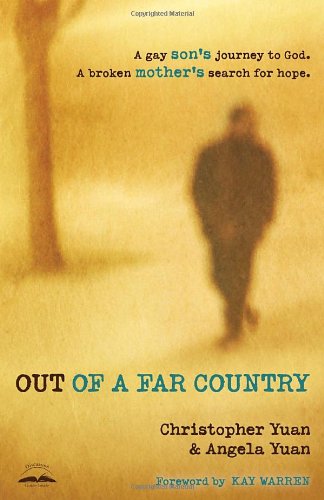
The phrase "surrendered his life to Christ" is also very characteristic of this short book, as it seems to constantly consider a person's coming to faith to be a battle between that person and God.  Angela Yuan routinely talks about trying to trick or coerce her son into accepting Christ by surrounding him with Christian radio in his parents' house, or taking him to hear a dynamic speaker who might be able to persuade him.  Moreover, she insists on stridently working her faith into conversations where it is not necessarily appropriate, such as a visit to the dean's office at the university her son attends.  As an Eastern Orthodox Christian, I can say honestly that it is this sort of combative attitude from Evangelicals that often turns me off , and one reason I reviewed this book was to discover what the middle ground was between my Church and other Christians.

The negatives having been mentioned, however, I did find some of that middle ground.  I was especially impressed with the fact that Christopher Yuan made clear that his mother's only attempts to "cure" him of homosexuality ended in abysmal failure, and he came instead to understand human sexuality in a different way altogether than I would have expected.  Let me be clear; this book does not endorse homosexuality as being compatible with Christianity, and neither do I, and nor does my Church.  In order to avoid complete spoilers, I will say only that the perspective on sexuality which Yuan finally reaches is one that I as an Orthodox Christian can accept, and I was not expecting that based on this book's cover.


Finally, this book is simply interesting, well-written, and to my surprise, rather suspenseful.  It held my interest, that's for sure.  Unless you're really put off by religious content in your non-fiction (or by non-fiction generally), you'll probably find this a quick, interesting read.

October 17, 2011

Review of "Pershing"

FULL MONTY:
Thomas Nelson, Inc., provided me with a free copy of this book in exchange for my honest review of it.  Per Uncle Sam's instructions, I have now made that fact glaringly clear.  Let me also make glaringly clear that Uncle Sam should be ashamed of himself for not seeing to it that I knew who the subject of this biography was BEFORE I read this book at the age of 34.

Generals John Pershing and George Washington are the only two men in American history who have held the rank of 6-star general, and Pershing was the only one who received it during his lifetime, rather than as a posthumous honor, author John Perry informs us.  You'd think we would all have heard more about this man, wouldn't you?  After reading this brief biography of him, I can only guess that his incredible story as Commander of the American Armies during World War I got lost, as did his entire war, in the greater monstrosity that was World War II.  (We STILL don't have a national monument for the soldiers of World War I, for goodness sake!)  I've been obsessed with history since childhood, so I figured I would enjoy this historical biography when I saw it listed as one of my choices, and indeed, I was right.

Pershing: Commander of the Great War is a very straightforward biography, setting forth the major themes and events of the general's life in chronological fashion.  At 224 pages, it is a somewhat shallow coverage of the subject, but its very brevity--along with an engaging writing style--make it accessible to the non-specialist.  Within a few pages, I found myself genuinely interested to see what happened next, and impressed that Perry's handling of a military hero fleshed out his personality enough to make me care about him as a human being.

A couple of discordant notes made the experience a bit jarring in places.  Foremost of these was the author's attempts to squeeze every possible bit of traction out of any mention Pershing ever made of his religious views or beliefs.  I understand that the book was commissioned and published by an overtly Christian publishing house, but Perry's efforts to make a religious figure out of an individual he had already labeled as a heavy drinker and a lady's man did not ring true.  The overall impression in the book is of a decent man with strong principles, devotion to duty, and his own take on right and wrong.  He's a likable figure, and a brilliant strategist, but a great moral leader he was not.

I was utterly baffled by Perry's handling of the end of World War I.  He talks about Pershing's views on the signing of an armistice, versus an unconditional surrender.  Though the general may not have been happy with events, and his pessimism was proven to be founded, Perry behaves as if Germany was given a slap on the wrist and this was the sole reason that World War II happened.  He never once mentions the crushing reparations demanded of Germany and the other Central Powers by the Allies, though it is generally accepted historical doctrine now that the humiliation Germans felt over those reparations helped vault Hitler into power.

Like most biographies of its kind, this book contains photographs of the subject and his family between each major section, with one significant difference.  I don't know whose brilliant idea it was to caption the photographs in such a way that they inform you of huge events about which you CANNOT POSSIBLY HAVE READ YET, but this was an enormous frustration.  I had to just skip over the photos and not even look at them after one maddening spoiler that made me almost want to stop reading.


Those grumbles having been put forth, however, I must say that I really enjoyed this book for what it was intended to be--an introduction to an extraordinary man whom Americans should never have been allowed to forget.  If you're looking for a good, sound history of WWI, this is not it.  Moreover, if military biographies bore you, this book probably won't be your cup of tea.  But if you like a solid story with characters you can cheer for and the poignancy that a true story brings to a book, you'll probably appreciate this one.

October 13, 2011

Review of "The Know-It-All"

I just finished reading The Know-It-All: One Man's Humble Quest to Become the Smartest Person in the World, by A.J. Jacobs, and decided to immediately share my impressions here, while they're fresh in my mind.  First off, let me say that I bought this book from my local swapping used bookstore several months ago, which means it qualifies as part of this month's "Read Your OWN Library! Challenge".  Yay!  Now, on with the review.

This is now the second book I've read by A.J. Jacobs--the first was The Year of Living Biblically: One Man's Humble Quest to Follow the Bible as Literally as Possible, which I can also recommend--and I have enjoyed them both, so I'm ready to declare officially that he is an entertaining author of non-fiction.  There's a touch of Woody Allen's self-deprecation in everything Jacobs writes, and enough honesty to admit that he thinks more highly of himself than he probably ought, which makes any hubris inherent in this project mostly excusable.  (BTW, I really can't stand Woody Allen most of the time, but I do find his early stand-up stuff where he was constantly deconstructing himself funny.  End of pointless and irrelevant bulletin.)

For anyone who hasn't already heard of this book, it is simply an account of one rather odd man reading his way through the entire Encyclopaedia Britannica.  Since I have often read brief sections of encyclopedias and dictionaries for fun, I find Jacobs to be my kind of odd person, though I won't be dashing out to replicate his experiment any time soon.  One of the coolest things about this book is that you actually learn quite a few interesting though useless facts, sort of gathering by osmosis the highlights of the ass-numbingly dull project this man took upon himself.  I found the structure of the book a bit off-putting when I first opened it and discovered that the memoir itself is arranged like an encyclopedia, but I quickly realized that I REALLY should have seen that coming, shouldn't I?  I mean, how else would he arrange it but alphabetically, according to the volume of the Britannica that he was currently slogging through at the time of writing?


This book--like its author and his long-suffering wife--has its annoying moments, times when I kind of wished he'd get back to the issue at hand and quit talking about his irritating brother-in-law, but for the most part, the real-life backdrop added whimsy and humanity to what could have been a very dull read, considering how dull Jacobs' source material was at times.  I enjoyed this book, and I recommend it to anyone who thinks the project sounds cool, but certainly has no intention of ever undertaking it for themselves.
Related Posts Plugin for WordPress, Blogger...